Black, navy, charcoal, gray, white, beige, camel and dark wash denim. We sorted the eight most common closet colors into three groups, then walked through the order for pairing them with four mornings: a Monday business trip, a school meeting, a reunion with old classmates and a Sunday grocery run. Also covered: beiges that clash with each other, and how to hang your clothes.
When you get ready for work, most of the time slips away in front of the closet. If you often stand there for a long while holding one pair of trousers and wondering what to wear on top, it's faster to group your colors into three sets by lightness. Below you'll find how to group them, the questions to ask when choosing a pair, and the outfits we actually put together on four different mornings.
1. Eight colors in three groups
This article uses eight colors as its base: black, navy, charcoal, light gray, white, beige, camel and dark wash denim. They are the basics that work for both work clothes and weekend wear, so if your closet is a little different, just swap in the closest color. Rather than memorizing each one, grouping them into three sets by lightness helps you choose quickly in the morning.
| Group | Colors | If you wear the same group together |
|---|---|---|
| Dark group | Black, navy, charcoal | The lightness is similar, so the line between top and bottom blurs. If you wear them together, make the fabrics clearly different. |
| Light group | White, light gray, beige | Soft, but it tends to look washed out in photos. Put one dark color somewhere in the outfit. |
| Middle group | Camel, dark wash denim | Rarely clashes beside either group. Good for outerwear or a bag. |
The basic way to pair is to take one color from each of two different groups. Dark trousers with a light top, or light trousers with a dark top. The middle group can sit between them or go on as a third piece.
2. Three questions for choosing a pair
Once you've pulled out either trousers or a top, ask these questions in order to choose the rest.
- Is the lightness at least one step apart between top and bottom? If both come from the same group, the top and bottom join up from a distance and the edge of the clothes disappears.
- Is there an even mix of warm and cool colors? Camel and beige lean warm, while navy and gray lean cool. Wearing only cool colors, or only warm colors, is fine. What looks busy is a similar ratio of the two, such as two warm colors and two cool ones. Use a lot of one side and a little of the other.
- How many pieces are outside the eight colors? Colors like burgundy, blue and mustard are enough at one piece a day.
3. Four mornings, four examples
A Monday business trip by KTX (high-speed train)
This is a day when you sit on a train for more than two hours, then step off and go straight into a client meeting. Cotton trousers wrinkle quickly behind the knees and across the thighs, so we chose charcoal wool trousers. Since the trousers are in the dark group, we took a light gray knit from the light group for the top. Two grays look calm, and a camel bag adds just a little warm color. There isn't a single colorful piece.
A school meeting for your child
You sit facing the teacher across a desk. The chairs in the meeting room are low and the desk hides everything below your waist, so almost all the teacher sees is your top. That's why you choose the top first. If you pick a navy knit, beige from the light group suits as the trousers. One cool navy and one warm beige keep it from looking busy. Letting a bit of a white shirt collar show at the neck of the knit makes the area around your face look brighter.
An evening reunion with old classmates
It's an occasion where you care about how you look, since you haven't seen these faces in a while. If you pulled out black trousers and a black knit, the top and bottom have the same lightness and the line between them disappears. Switch the top to a camel knit and a difference in lightness appears, and one warm color plus black looks neat. If the restaurant is heavily heated, wear a camel shirt with a black jacket instead of a knit. Even after you sit down and take off the jacket, the camel and black pairing stays.
A Sunday morning at the grocery store
Dark wash jeans with a white T-shirt, and a navy windbreaker on top. All cool colors, so it looks calm, and the dark wash and white create a lightness difference. It's a day of long walks with a shopping bag, so keep to white sneakers. The bright break between the hem of the trousers and the shoes keeps the dark wash outfit from looking heavy.
4. When one piece goes outside the eight colors
If you only rotate the eight colors, there comes a day when you look like the same person every day. When you bring in a colorful piece, you'll fail less often if you decide first which of the eight colors it will pair with.
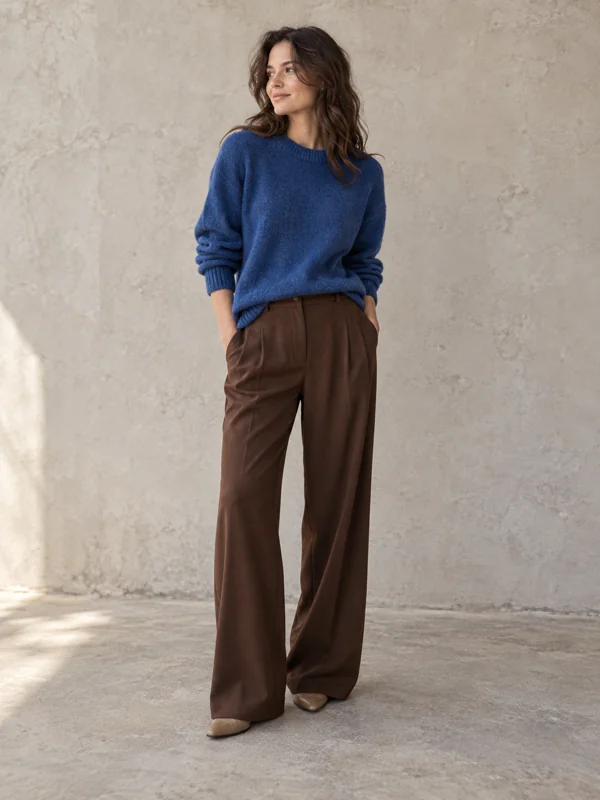
There are a few more pairs that are easy to put together the same way. A lavender blouse with navy trousers, a sage shirt with cream trousers, a dusty pink knit with gray trousers. Each one is a colorful piece plus one of the eight colors, so you can fill in the rest, outerwear and shoes, with clothes you already own.
5. Same name, colors that don't match
There are days when you followed the chart and something still feels off. Usually the colors carry the same name but are actually different colors. Beige alone comes in a yellowish beige, a pinkish beige and a grayish beige. Put a pinkish beige knit with yellow beige trousers, and both are beige, yet they look like faded clothes next to each other.
The same thing happens with white. Layer an ivory knit with a yellow tint over a bright white shirt with a blue tint, and the ivory tends to look like clothing that has yellowed from long wear. If you want to wear them together, change the shirt to light blue or gray, or put beige or camel trousers under the ivory knit so the yellow tint carries into a warm color. For white clothes you bought online, hold them next to a white piece you already own before you remove the tag, and the difference shows right away.
6. How to hang your clothes, and a check before you go out
If you hang your clothes by group, your hand wanders less in the morning. Separate a section for tops and one for trousers, and within each section hang from the left in this order: dark group, middle group, light group. If you pull the trousers from the far left, your hand reaches to the far right for the top. If you gather the colorful pieces together at the very end of the section, the habit of taking out just one a day forms on its own.
Before you put on your shoes at the front door, check just these five things.
- Top and bottom don't come from the same group?
- Warm and cool colors aren't mixed half and half?
- No more than one piece outside the eight colors?
- The same beige, the same white, don't clash in tint?
- Do the shoes connect to the trousers or to the top?
The last item doesn't have a set answer. Matching shoes to the trousers makes your legs look longer and continuous, while matching them to the top or bag ties the upper and lower halves together once more. On workdays match them to the trousers, and on days when you'll be photographed match them to the top.