Tone-on-tone in one family, like beige, cream, camel, and brown, comes alive when you vary the fabric and lightness. Starting from an all-cotton beige outfit, we changed it layer by layer with a knit, corduroy, wool pants, and leather shoes, and followed what changes, all the way to a trench outfit on a cloudy spring day.
If a beige-on-beige outfit looks flat, it's often not the color but the fabrics, which are all smooth. Starting from one all-cotton beige outfit, I changed one thing at a time and noted where it started to look different.
1. Starting point: all-cotton beige
Let's start with the most common spring outfit: a beige cotton trench coat, a beige cotton T-shirt underneath, and beige chino pants below. All three are cotton and similar in lightness. Each piece looks fine alone, but together the surfaces are all smooth and the lightness is the same, so it's hard to tell where one piece ends and the next begins.
Without changing the color, let's work only on texture and lightness.
2. Swapping the top for a knit
Swap the cotton T-shirt underneath for a cream ribbed knit. The color is nearly the same family, but the ribs catch light and split into lighter and darker lines like stripes, setting it apart from the trench's smooth surface. The fuzzier the knit, the more softly the light spreads, so the area under your face looks warmer.
Knit thickness matters too. A thin fine-gauge knit is as smooth as a cotton tee, so the effect is small. The chunkier the cables or ribs, the more the texture shows. Under a spring trench, a mid-weight rib that isn't too thick is comfortable.
The neckline makes as much difference as the texture. When a crewneck knit shows between the trench lapels, a round line of cream appears under the beige outerwear. With a turtleneck, the same family covers up to your neck and the tone-on-tone feel gets stronger. If you have a rounder face and covering your neck feels stuffy, a crewneck or V-neck is more comfortable.
3. Swapping the pants for corduroy or wool
Next, the pants. Even in the same beige, corduroy can look lighter or darker depending on the direction of the ribs and the viewing angle, and wool pants have a slightly soft surface that makes the color less shiny. With the top already a knit, changing the pants to a different texture makes top, bottom, and outerwear three different fabrics, so the three layers separate clearly even within one color.
The thicker the corduroy ribs, the more casual it looks. For work, thin-rib corduroy or wool trousers are better. For a weekend walk, thick ribs work well too.
Where corduroy ribs get pressed down from sitting a long time, that spot catches light differently and can look like a stain. On a day with a long drive or a long meeting, wool pants are less of a worry.
4. Widening the lightness by one step
If changing the fabric isn't enough, widen the lightness. Tone-on-tone moves only the lightness within one family, so the wider the range, from cream to brown, the easier it gets.
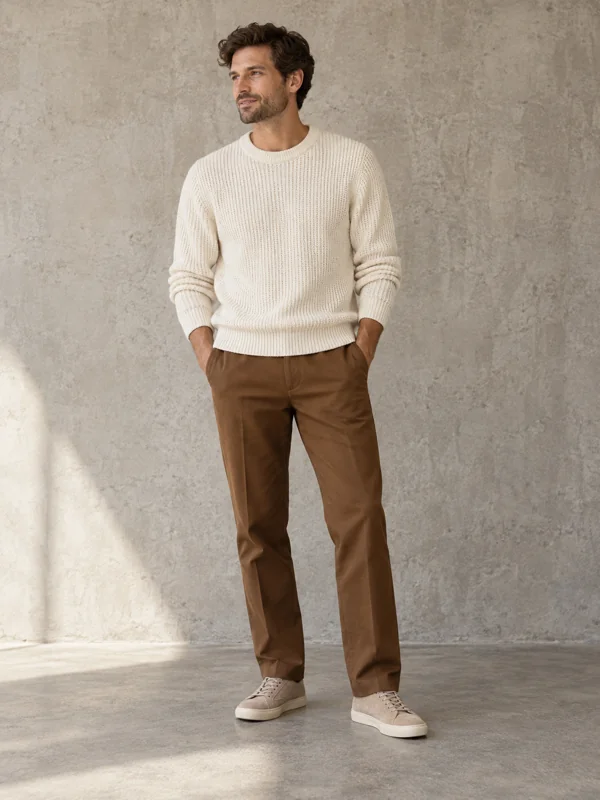
If you're trying tone-on-tone for the first time, the easy order is as in this photo: lightest on top, darkest on the bottom. If you flip it, with brown on top and cream below, the eye drops down and your lower body can look wider. If you add outerwear, pick a lightness between top and bottom, like the beige trench, and the three layers step down like stairs.
5. Leather shoes and bag
If everything is fabric, add one last thing in leather. Brown leather loafers or a bag are in the same family as the clothes and have a subtle sheen on the surface, which tidies up the lower part of an all-fabric outfit. Keep shoes and bag deeper than the pants and similar in lightness to each other, and the look feels put together.
White sneakers are fine too. But if everything is light, from a cream knit to a beige trench to white sneakers, the line between outer and inner layers weakens. On days you wear white sneakers, carry a deep brown bag to balance the light and deep sides.
6. Cloudy spring days and sunny days
On an April cloudy-day commute, it seems like an unusual number of people are wearing beige trenches. On cloudy days the light spreads evenly and fabric shadows weaken, so differences in texture show less than on clear days. So on cloudy days, lean on lightness differences rather than fabric differences. Switch the pants to a deeper brown, or wrap a scarf in deep camel.
Sunny days are the opposite. Shadows deepen in the knit ribs and corduroy ribs, and the same beige looks much more dimensional. If you plan to take outdoor photos on a clear day, narrowing the colors to between cream and beige is enough.
7. The changes in order
| Step | What changed | What's different |
|---|---|---|
| Start | Cotton trench, cotton tee, cotton chinos | Same color and surface, so no edges show |
| 1 | Cream ribbed knit inside | Texture appears under the face and separates from the outerwear |
| 2 | Corduroy or wool pants | Three layers in different fabrics, each one visible |
| 3 | Brown pants | Lightness steps down, so it stays clear even on cloudy days |
| 4 | Brown leather shoes and bag | Glossy leather tidies up the lower part |
You don't need to do all four steps. Changing just one or two with what you already own makes it look quite different from the starting point. If you already have a cream knit, start at step 1. If you have brown pants, start at step 3.